Sunday, December 10, 2023

Python for AutoCAD, Using shapely to find an oriented bounding box.


I see this asked frequently in the AutoCAD forums “How do I get the bounding box of an entity”, and the standard answer is usually, “Use vla-GetBoundingBox”, or get the entity extents. This is the correct answer, caveat, the bounding box is aligned with WCS, so if your object is rotated the result may not be what you need.

 One option is to transform the object to align with WCS. Or we can use a 3rd party tool like Python’s shapely to help. 


here's an example:

import traceback
from pyrx import Ap, Ax, Db, Ed, Ge, Gi
from shapely import LineString


@Ap.Command()
def mybb() -> None:
    try:
        # create a selection set filter and select the polylines
        filter = [(Db.DxfCode.kDxfStart, "LWPOLYLINE")]

        ps, ss = Ed.Editor.selectPrompt("\nSelect parts: ", "\nRemove parts: ", filter)
        if ps != Ed.PromptStatus.eNormal:
            return

        # iterate the selection set
        for id in ss:

            # create a LineString from our polylines
            pline = Db.Polyline(id)
            ls = LineString(pline.toList())

            # get the oriented bbox
            coords = ls.oriented_envelope.exterior.coords

            # convert tuples to Ge.Point3d
            points = [Ge.Point3d(p) for p in coords]

            # #draw the results
            Ed.Core.grDraw(points[0], points[1], 1, 0)
            Ed.Core.grDraw(points[1], points[2], 1, 0)
            Ed.Core.grDraw(points[2], points[3], 1, 0)
            Ed.Core.grDraw(points[3], points[0], 1, 0)
    except Exception as err:
        traceback.print_exception(err)


Saturday, December 9, 2023

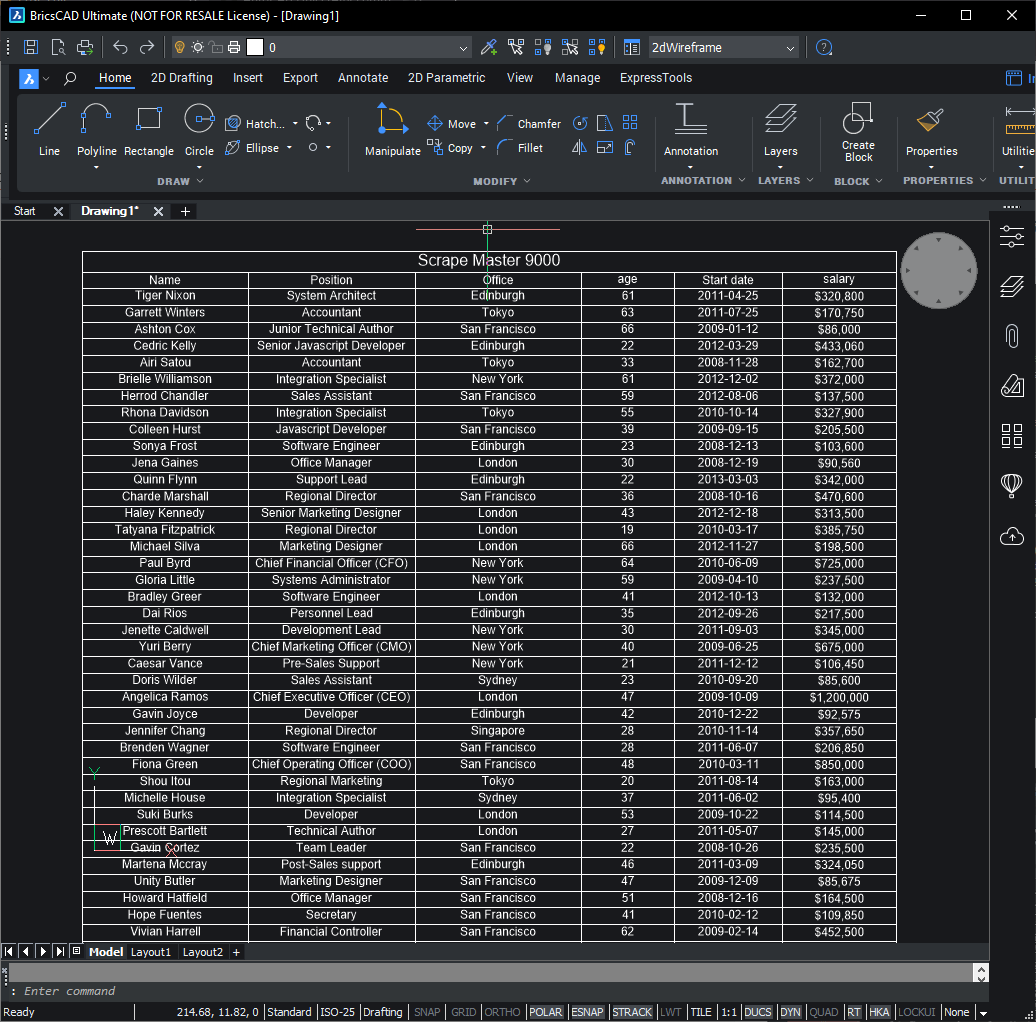
Web Scrape to a BricsCAD table using Python and PyRx


I thought this interesting. I could imagine using python to scrape some industry specific data, maybe a spec sheet or a materials list into a Table. Possibly a useful tool for importing “DATA” into a drawing.

 This example uses BeautifulSoup, Requests and Pandas


import traceback
from pyrx import Ap, Ax, Db, Ed, Ge, Gi
 
import requests
from bs4 import BeautifulSoup as bs
import pandas as pd


# sample source https://www.scraperapi.com/blog/python-loop-through-html-table/
def scraper9000():
    url = "https://datatables.net/examples/styling/stripe.html"
    response = requests.get(url)
    soup = bs(response.text, "html.parser")
    table = soup.find("table", class_="stripe")
   
    data = {
        'Name': [],
        'Position': [],
        'Office': [],
        'age': [],
        'Start date': [],
        'salary': [],
    }
    for employee_data in table.find_all("tbody"):
        for row in employee_data.find_all("tr"):
            data['Name'].append(row.find_all("td")[0].text)
            data['Position'].append(row.find_all("td")[1].text)
            data['Office'].append(row.find_all("td")[2].text)
            data['age'].append(row.find_all("td")[3].text)
            data['Start date'].append(row.find_all("td")[4].text)
            data['salary'].append(row.find_all("td")[5].text)
           
    return data

@Ap.Command()
def doit():
    try:
        db = Db.curDb()
        df = pd.DataFrame(scraper9000())
 
        table = Db.Table()
        table.setDatabaseDefaults(db)
 
        # add one for the title and header
        table.setSize(df.shape[0]+2, df.shape[1])
 
        #title
        table.setTextString(0, 0, "Scrape Master 9000")
       
        headers = df.columns.values.tolist()
        datas = df.values.tolist()
 
        for col, value in enumerate(headers):
            table.setTextString(1, col, "{}".format(value))
 
        for row, data in enumerate(datas):
            for col, value in enumerate(data):
                table.setTextString(row+2, col, "{}".format(value))
 
        model = Db.BlockTableRecord(db.modelSpaceId(), Db.OpenMode.kForWrite)
        model.appendAcDbEntity(table)
 
    except Exception as err:
        traceback.print_exception(err)


TraceBoundary sample in Python for AutoCAD

    import traceback from pyrx import Ap , Db , Ed , Ge , Gi @ Ap . Command () def TB () -> None :     try :         db = Db . curD...